
COROS vs. Garmin: I Wore Both for 3 Years
I’ve been wearing both a Garmin and COROS for almost all my runs the past 3 years (yes, I look ridiculous with a watch on both wrists haha).
In 2021, I joined the Garmin defectors when my Vivoactive 3 Music died after almost 2.5 years. I used the COROS APEX for a year and was happy with it. Then, in 2022, so many GPS watches were coming out that I started to wear two watches for all my runs so I could test multiple units.
After 3 years of wearing both a Garmin and COROS, I’m able to give you my first-hand experience on the differences between the two ecosystems, including features and metrics. I’ll also share my favorite watch recs for both companies.

As some context, I’m a road marathoner, but I’ve also dabbled in triathlons and trail running. I’ve had the chance to test dozens of Garmin and COROS watches since 2018, mainly from media loaners. I do a lot of GPS watch comparisons, so if you’re deciding between specific models, take a look at those!
Note: This post was published in 2021, overhauled in 2023, and updated again in 2025 and 2026. This post contains affiliate links and codes, meaning I’ll receive a small commission at no extra cost to you if you purchase through those links/codes.
A Quick Summary: Garmin vs. COROS


If you want the quick and easy summary, here are the main ways Garmin and COROS differ. Keep in mind that many features are model-specific, so be sure to double-check before purchasing!
Garmin:
- Has more lifestyle and smartwatch features, such as contactless payments, compatibility with Spotify, and AMOLED displays.
- Offers safety features like Incident Detection and Livetrack.
- Has Body Battery, Sleep Coach, other fitness-adjacent metrics/suggestions.
- Is less buggy overall since it’s a bigger brand (COROS can sometimes have bugs with its performance metrics).
COROS:
- Is more fitness-focused; all watches have performance metrics like race predictor, training load, and recovery time.
- Has better battery life—depending on your usage, you may only need to charge every 2-3 weeks (compared to every 1-2 weeks for any equivalent Garmins)
- Provides regular software updates bringing major new features, such as more tracking profiles or performance metrics.
- Offers better warranty policy (2-years, and replacements are always new watches—not refurbished like Garmin after 3 months).
After using both for a few years, I don’t actually have a clear preference. I love how sleek the new Garmin devices are and how clean their tracking is, but I also appreciate how I barely have to charge COROS watches and how value-packed they are.
If you want to learn more about some reasons to pick one ecosystem over the other, let’s dive into the rest of the post! I’ll first start with reasons to choose Garmin or COROS over the other, and then dive into the actual differences in the data that I observed. Finally, if you want watch recs, I got you at the end.
Just need a quick watch recommendation?
For Garmin, the Forerunner 265 is a staple choice, with music streaming apps, LiveTrack, and a variety of activity tracking profiles. It also has a smaller size option, which I prefer for my small wrists.
For COROS, the PACE 4 is packed with value and is lightweight, lasts 19 days, and tracks multisport. (Use code COROS-Lily for a free, extra watch band at checkout).
Reasons to Choose Garmin
More Lifestyle and Smartwatch Features
The primary difference between Garmin and COROS is that Garmin has more everyday fitness and lifestyle features, while COROS is more focused on performance metrics.
As a result, Garmin watches have more smartwatch functionalities. Some have Garmin Pay, which allows you to use your watch for contactless payments. Others let you store music by direct download or from apps like Spotify Premium, Deezer, and Amazon Music; you can then listen via Bluetooth headphones.

All current generation COROS watches have music functionality, but it’s MP3 files only (you have to be a GIANT brand to get a contract with apps like Spotify).
Several Garmin watches even have touchscreens and AMOLED displays (the bright color, high-contrast display that you get on your phone). This includes even the newer sports-focused watches, the Forerunner 265, 570, 965, and 970, which was a big shift since those features were previously limited to the lifestyle series like the Venu and Vivoactive.
All current-generation COROS watches have touchscreens as well, but only the PACE Pro and PACE 4 have the AMOLED display.
Safety Features Detect Incidents + Alert Emergency Contacts
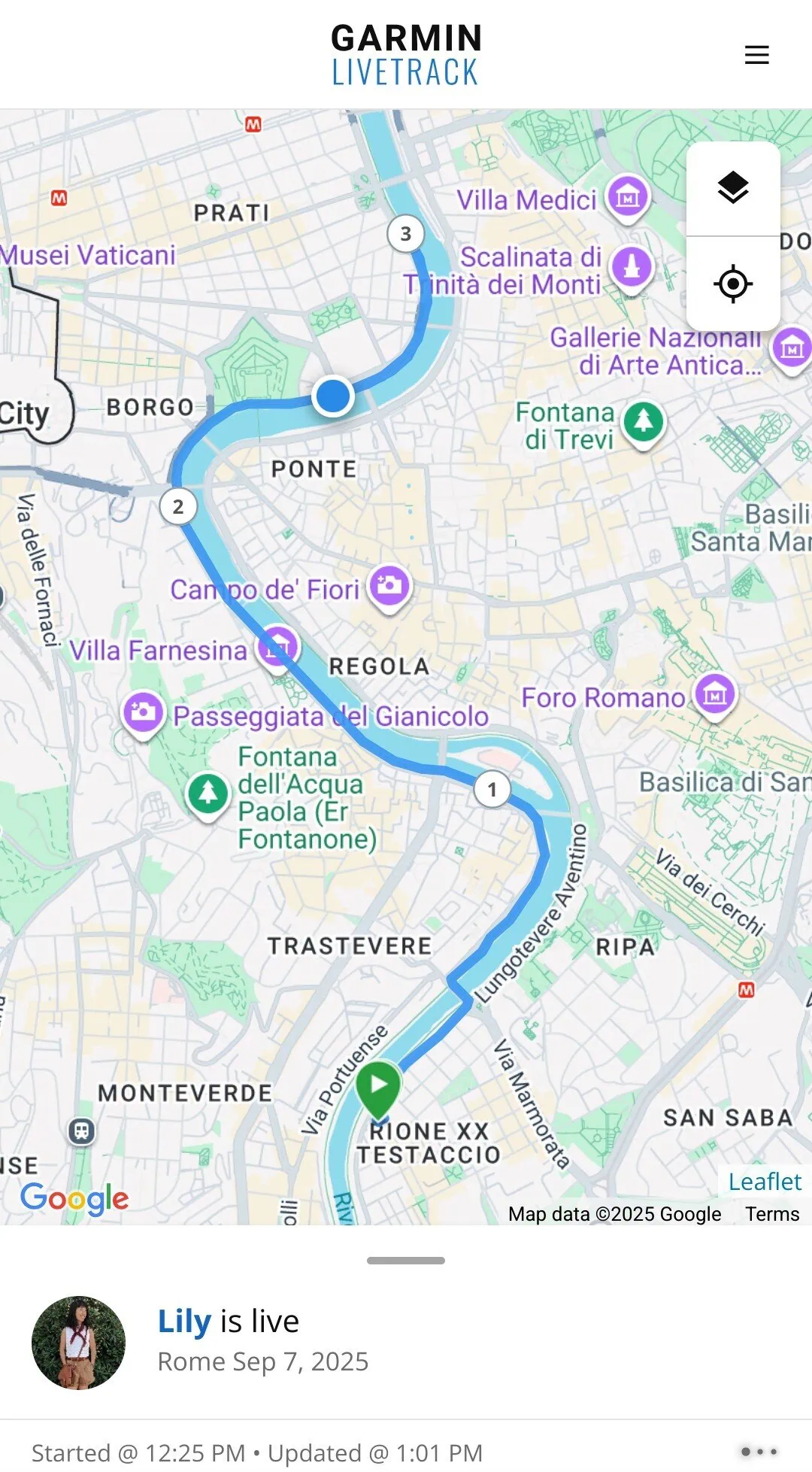
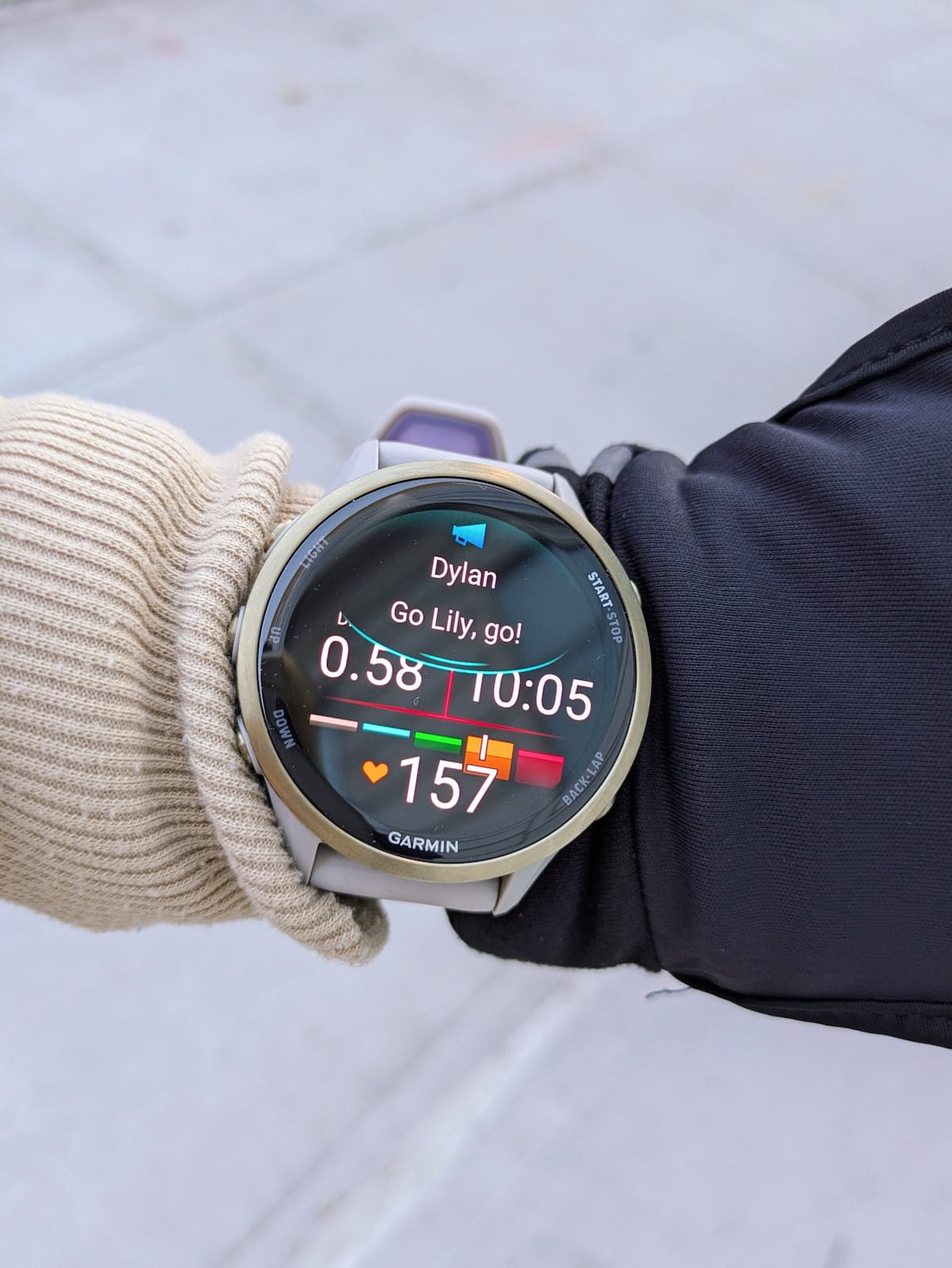
Nearly all current generation Garmins have Incident Detection and LiveTrack. For both, you must be connected to your phone for them to work. Incident Detection will alert your emergency contacts if it detects an accident during running, biking, or walking/hiking. LiveTrack allows you to share your location in real time, and your loved ones can send motivational messages as well.
COROS does have live tracking and emergency alerts, but it doesn’t have Incident Detection; you have to manually send the alert. Its live tracking is also much less intuitive and you need to do a workaround through Group Tracking, so I haven’t actually used it since it’s confusing.
More Overall Health & Fitness Tracking
Garmin allows you to track some pretty helpful things, including the following:
Sleep Coach: While all current generation COROS and Garmin watches have sleep tracking and nap detection, Garmin also offers Sleep Coach. This feature advises you on how much sleep to aim for based on your sleep and activity history plus heart rate variability.

Body battery: Body Battery, which tells you your energy levels based on heart rate variability, stress, and activity.
ECG: select Garmin models, such as the Venu 3 and Fenix 7, can take ECG recordings. If you aren’t familiar with it, ECG stands for electrocardiogram and it records the electrical activity of your heart; it lets you know whether you have a normal or abnormal rhythm (known as AFib). Left untreated, AFib can lead to stroke, heart failure, and other problems since it causes improper blood flow to the heart. Of course, this is no substitute for proper cardiac monitoring devices, and you should consult your cardiologist to see if this would be useful for you because most doctors do not recommend routine AFib screening (and certainly not young, healthy runners).


During or before your runs, you may also find these features helpful (keep in mind they’re not available on all Garmins—only the latest models):
- PacePro: Creates a pacing plan for your races and runs, based on elevation and your goal time. You can also adjust the plan based on whether you want a positive, negative, or even split, and based on whether you want to take uphills easy or hard. COROS has a virtual pacer, but it doesn’t allow for customization based on the course, splits, or hills.
- Suggested workouts: Gives you workout ideas with duration and pace to build up different areas of fitness. COROS has a workout library, but it doesn’t have an automatic daily suggested workout feature.
More Frequent Heart Rate Readings
Garmin takes heart rate readings multiple times per second regardless of whether you’re resting or working out. COROS takes readings every 5 minutes while resting (with Daily Stress tracking activated) and every second during workouts.
Some have also complained that COROS workout heart rate readings are inaccurate, though I personally haven’t had an issue with them. Optical HR is never perfect, so I’d recommend an external strap for workouts if you’re doing heart rate training.
Either way though, if you’re looking for more frequent readings, go with Garmin.
Better Third-Party App Compatibility
While both COROS and Garmin can sync to Strava, you may find that Garmin is compatible with more running apps you use, such as MapMyRun and MyFitnessPal. There are sometimes workarounds where you can instead sync Strava to these apps, but Garmin is a bigger company, so it will directly be able to connect to more third-party apps.
By the way, if you want to see what I’m currently testing/using, you’re welcome to follow my Strava.
Maps Are More Detailed
For the devices with full mapping, Garmin has more detailed maps with street and landmark names. This can make a big difference in orienting yourself if you’re out on the trails often.
Garmin devices also come preloaded with landscape and topographic maps, while not all COROS devices have topographic maps preloaded (the VERTIX 2 I tested did, but the APEX 2 Pro and APEX 2 didn’t). It’s easy to download maps from the COROS site and upload them to your watch, but just keep in mind that it can take a couple hours since they’re usually large files. I also had to reach out to support to match the right files to the right folders, since my computer wasn’t showing the same options as the instructions.


Ability to Pair to Accessories via ANT+
If you use any accessories that pair ANT+ only (certain HR straps, bike power meters, speed sensors, etc.), you’ll want to go with Garmin, as all current-generation COROS models only support Bluetooth pairing. Their older models do support ANT+, however.
Reasons to Choose COROS
Better Battery Life
COROS watches are known for their unparalleled battery life. Depending on the model, you get at least 30 hours on GPS and 17 days with regular use. Combining both GPS and regular use, I only have to charge my watch about every two weeks (with the latest PACE 4, you can even get 19 days of battery life in smartwatch mode!)
Garmin has improved their battery life significantly, though. On some entry- to mid-tier models, you can get close to two weeks in smartwatch mode and 20-30 hours in GPS mode. Still, when compared to the COROS equivalent in the same tier, COROS has 20-50% better battery life.
As of early 2025, COROS added stress tracking, which reduced regular use battery life significantly for older models (for example, it cut the PACE 3’s battery life from 24 days to 15). However, if you don’t need this feature, you can disable it and regain battery life. Stress tracking didn’t impact battery life estimates during tracking. Garmin has stress tracking but it can’t be disabled.
A quick note: because of the amazing battery life, you are unable to change the screen brightness for non-AMOLED display COROS watches (everything but the PACE Pro and PACE 4). I find the watches very readable despite that, but it could be an issue if you need a very bright screen.

Multisport Features at a Lower Price
Unlike Garmin, every COROS watch has open water, triathlon, and multisport modes. This used to be a big deal as you had to pay $100+ more to get open water swimming on Garmin, but when the FR165 was released, the pricing became pretty equivalent ($250 for the FR165 and $230 for the COROS PACE 3, and now $250 for the PACE 4).
However, to track triathlon/multisport (one activity with separate disciplines), you still need to buy a mid-range Garmin (FR255 or above), or track your activities separately.
More Accurate Swim Tracking
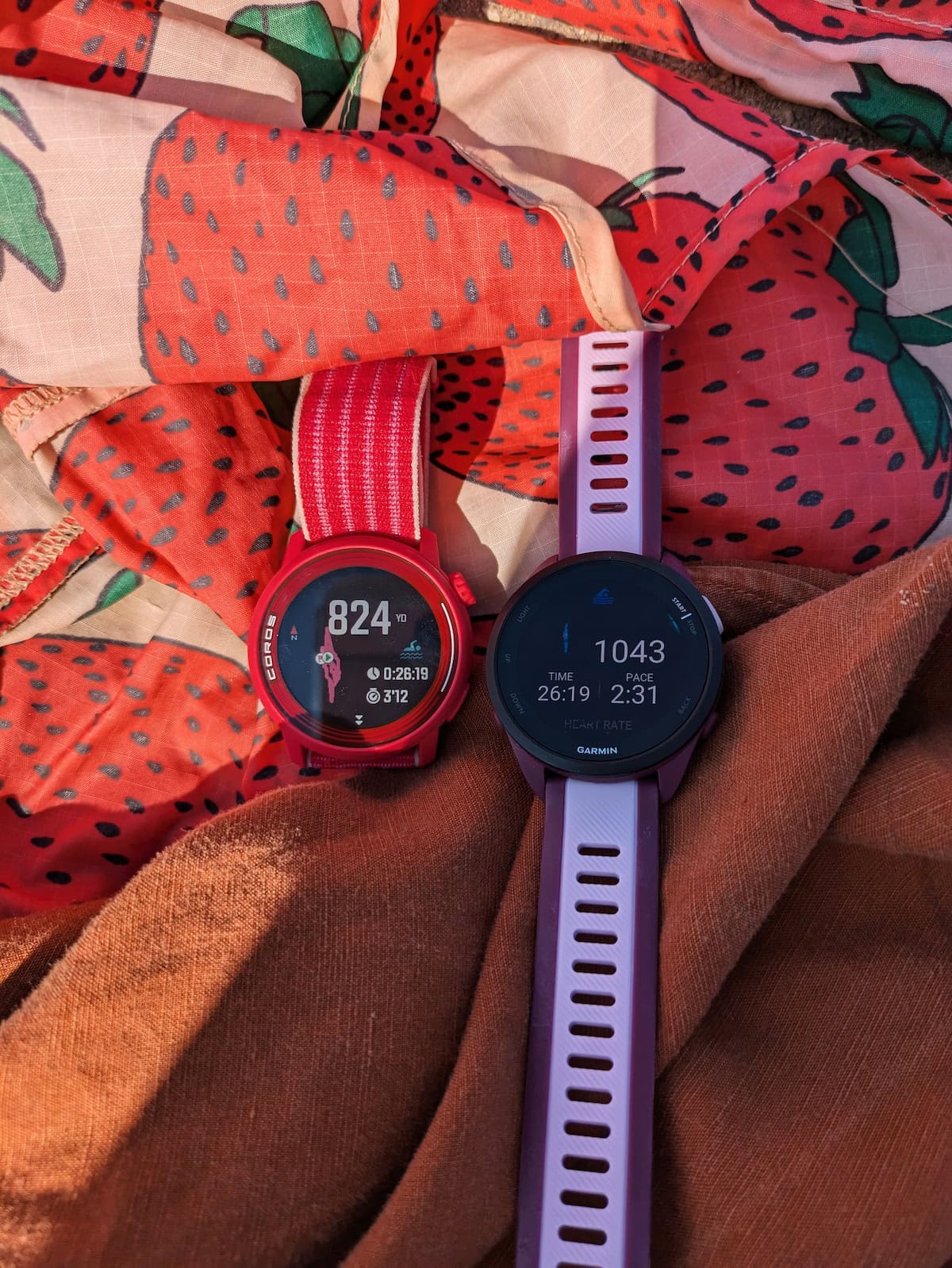
Speaking of swim tracking, I’ve found that COROS watches more accurately track my pool distances. To be fair, I’m not the strongest swimmer, but with Garmin, the distance was almost never correct—in fact, it was usually 10-15% longer. With COROS, the distance has been on the dot, and the watches also recognized my stroke type accurately.
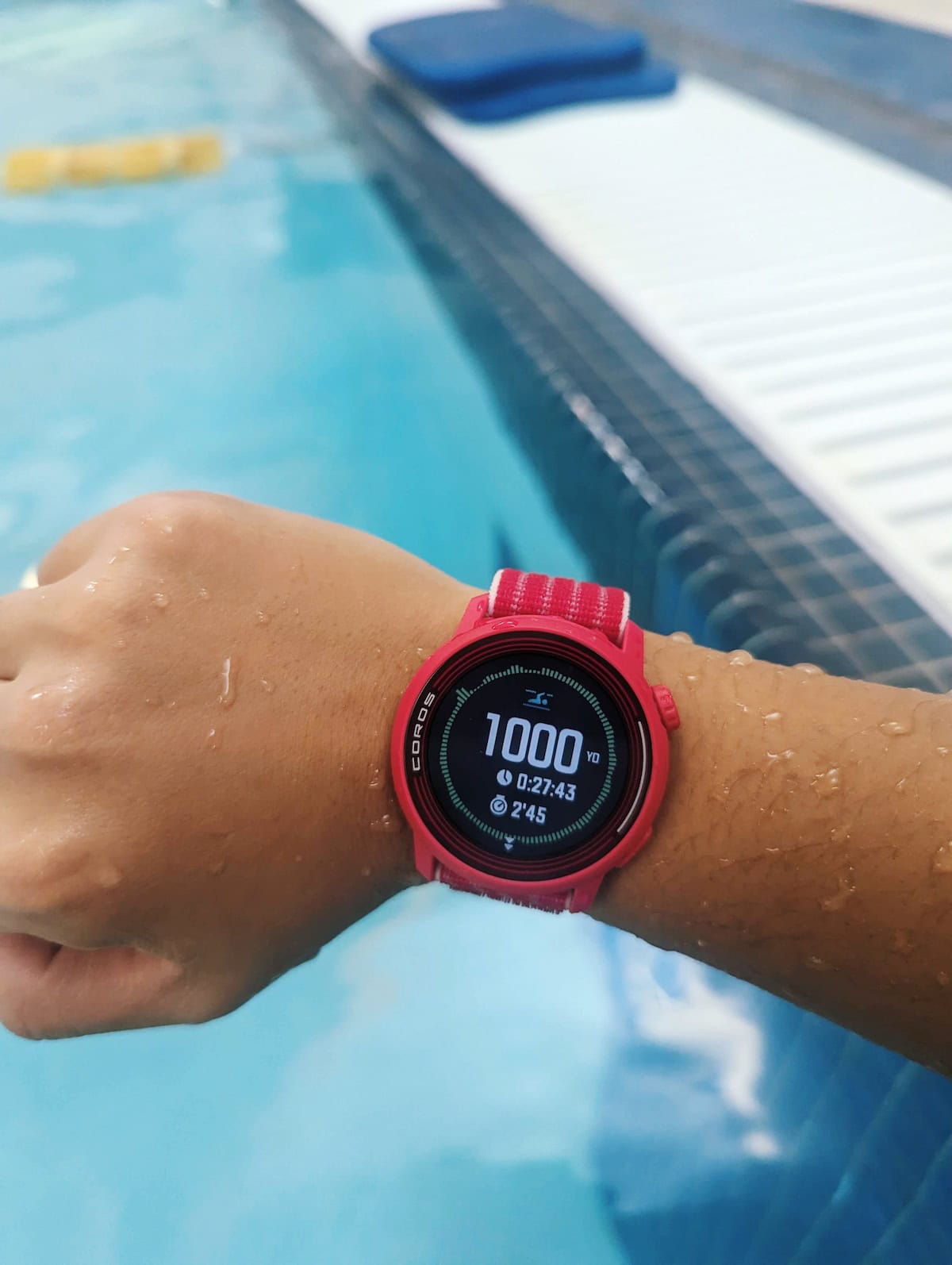
I found the same to be true with open water swimming: Garmin overtracked while COROS was more realistic. You can see the stats from an open water swim below—there was no way I swam faster in open water than in a pool.
More Reliable and Quicker GPS Signal (only if you’re considering an older Garmin)
Every COROS watch I’ve tested has consistently found GPS signal within a few seconds. After testing all the COROS units over the past few years, I’ve only had to wait longer than that a handful of times, and even then it was less than a minute (it was mainly the APEX 2 Pro in a very specific parking lot haha).
Garmin has improved GPS acquisition time a LOT over the last couple years, however. For watches released before 2022, it could consistently take up to a minute for them to find signal, especially if I’d changed locations recently (the FR245 was particularly slow). My Vivoactive 3 Music generally latched onto signal within 10 seconds, but once every couple months, it would take several minutes.
Every Garmin model I’ve tested that was released after the FR255 (Summer 2022) has generally been pretty quick. The FR955 was just as quick as COROS at finding signal, and the FR265S and Vivoactive 5 have also been speedy. The FR255 still was a bit slower (~12 seconds slower than the equivalent APEX 2), but much better than the FR245.
If you care about GPS acquisition time, I highly recommend getting a COROS or a newer Garmin model (and avoid getting an older Garmin).
All Watches Have Performance Metrics
All COROS watches have metrics such as Training Load, Training Status, Recovery Time, and Race Predictor. Garmin has equivalent metrics, but they’re not on all their devices, especially the more lifestyle-oriented models.

All Watches Have Barometric Data
Some budget to mid-range Garmins surprisingly don’t have a barometric altimeter, while all COROS watches do. The barometric altimeter allows you to have more accurate elevation data, see real-time changes in elevation during workouts, and track floors climbed throughout the day. COROS even shows barometric pressure on the watch, which also helps you predict short-term changes in weather (there’s also a storm alert).
I will say that the elevation can become inaccurate if there are changes in atmospheric pressure during your run. So, I’d say the lack of barometric altimeter may only be a dealbreaker if you plan to do a lot of hikes or trail runs, where GPS elevation isn’t as accurate. Whether you have a barometric altimeter or not, you can always use Strava to correct your elevation stats based on their data.

Ability to change the watch face orientation
COROS allows you to change the watch face orientation, so the buttons work on either the right or left side. You can also change whether scrolling down makes the page move up or down.
This is especially useful if you’re left-handed or want to wear the watch on your non-dominant wrist (I’m right-handed and actually prefer to wear COROS on my right since the default settings have the buttons on the right).

Longer Warranty and Regular Updates
COROS comes with a two-year warranty, while Garmin has just one year. Garmin also will only replace your watch with a refurbished one if you’re beyond 3 months into your warranty. I know this because the heart rate monitor of my Garmin Vivoactive 3 started getting scratches/cracks within a few months, but I didn’t contact support about it until after my warranty had passed. (This is apparently a known issue with Garmin by the way, so look out for this if you go with them).
COROS will replace a defective watch with a new one no matter where you are in your warranty.
One other thing that’s pretty cool about COROS is that they continue to bring new features to the watches, such as the EvoLab release in summer 2021, which gave users more running performance metrics (including Marathon Level, Running Performance, and Training Load, among others).
There was another bigger update in spring 2023, which gave users the Running Fitness test + metric and Training Status metric. The COROS PACE 2 even got breadcrumb navigation, which was huge.
Even better, discontinued watches will even receive these updates, if there’s enough memory on them (so for example, the original PACE got the EvoLab update in 2021, but the original APEX was not able to get all updates due to memory limits).
In 2024-2025, some notable updates received were:
- Virtual Pacer
- Bouldering mode
- Safety alerts
- Nap tracking
- Gear tracking
You can check out the release log for more info.
Differences in My Data: Garmin vs. COROS
There weren’t a ton of major differences in actual running and performance metrics, but these are the main three I’ve observed over several training cycles.
Race predictor—Garmin tends to overpredict, but does better after fitness breaks (tie)
Both the Garmin and COROS race predictors have generally been pretty similar for me, but Garmin does tend to predict faster times.
Before the Berlin Marathon in 2023, Garmin predicted a 3:51:29 marathon for me, which would’ve been a PR by 2 minutes. I knew I was nowhere near in PR shape after coming back from an injury. For the race-specific widget on Garmin, which takes into account the course (and likely the extra distance you’ll inevitably run), they had me at a 3:54:14, which was still basically PR shape.


On the other hand, COROS predicted 4:13:35, which I felt was a little too conservative.

In the end, I ran a 4:09:34, so COROS was a lot closer (4 minutes off vs. Garmin’s 15-18 minutes). After the Berlin Marathon, my COROS race predictor also updated to basically match what I’d run during the race (4:07), however, my Garmin updated to an even more unrealistic number (3:49).


On the flip side, my predictions were very similar for the 2024 Paris Marathon: 3:55 for Garmin and 3:59 for COROS. That race was a dud for me since I slept poorly the night before and my ex showed up and surprised me in the middle of the race, so I didn’t run anywhere near those times (we love drama). Just thought it was worth mentioning that the predictions seemed to become very similar over time.
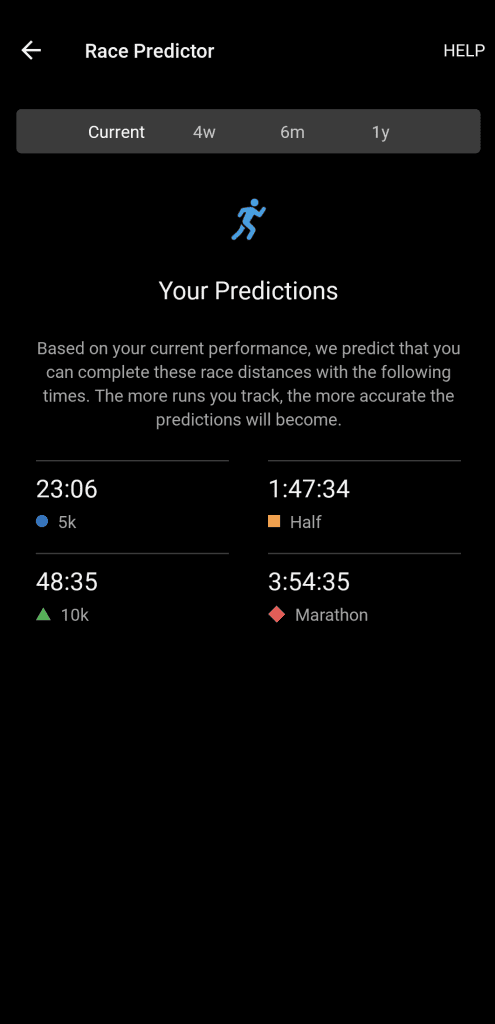
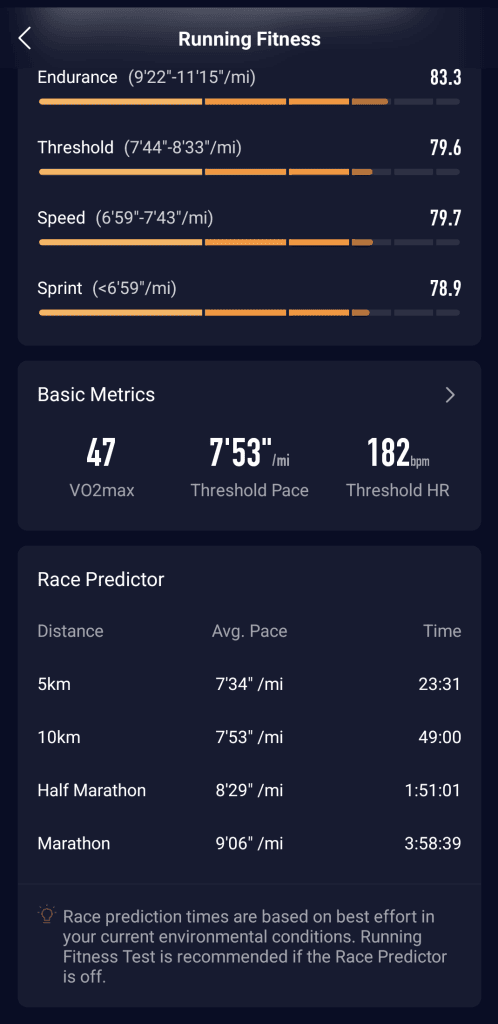
Finally, for half marathons, I’ve generally had a better experience with Garmin, especially since it does a better job adjusting to fitness loss. At the 2025 NYC Women’s Half, I ran a 1:59 and Garmin predicted a 1:58. COROS predicted a 1:52. I don’t think COROS took into account my lower training load over the month leading up to the race, as I had twisted my ankle. I do think I was in shape to run in the low 1:50s before my injury though.
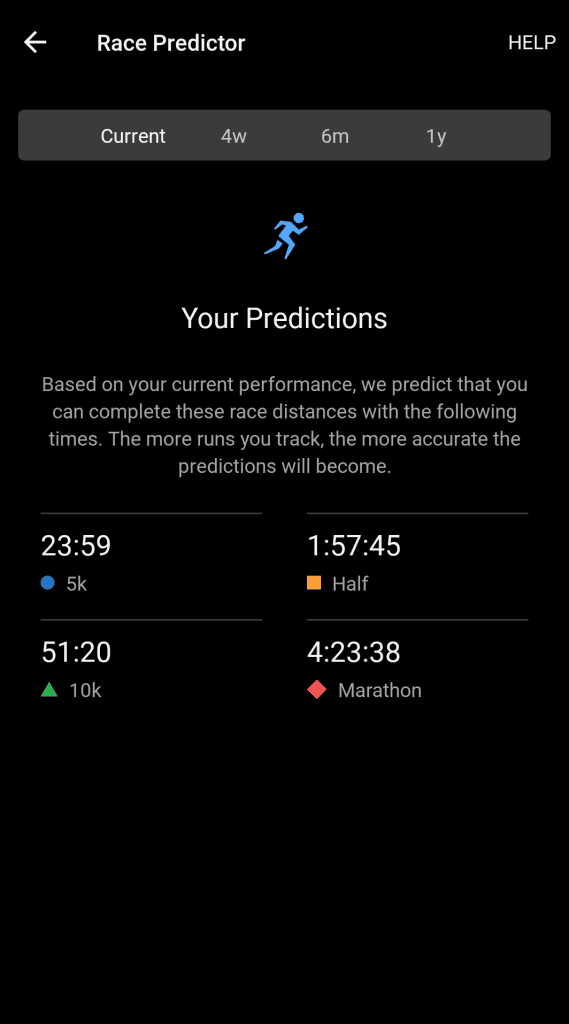
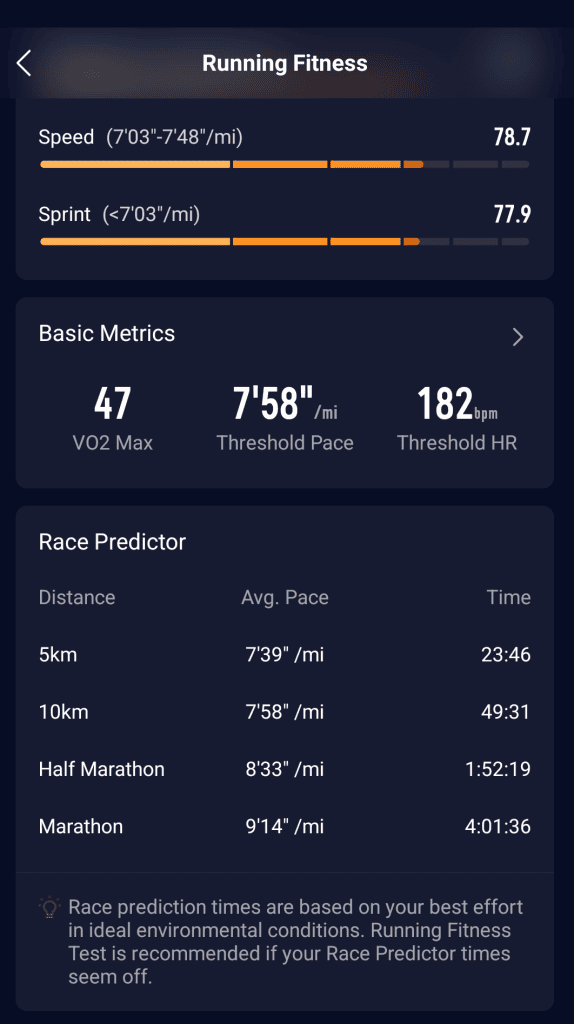
At the 2024 Mesa Half, Garmin also predicted a 1:49 and COROS a 1:56. I finished in 1:51. I went out at 1:55 pace though, and I’m glad since it allowed me to run a negative split and feel strong the entire race.
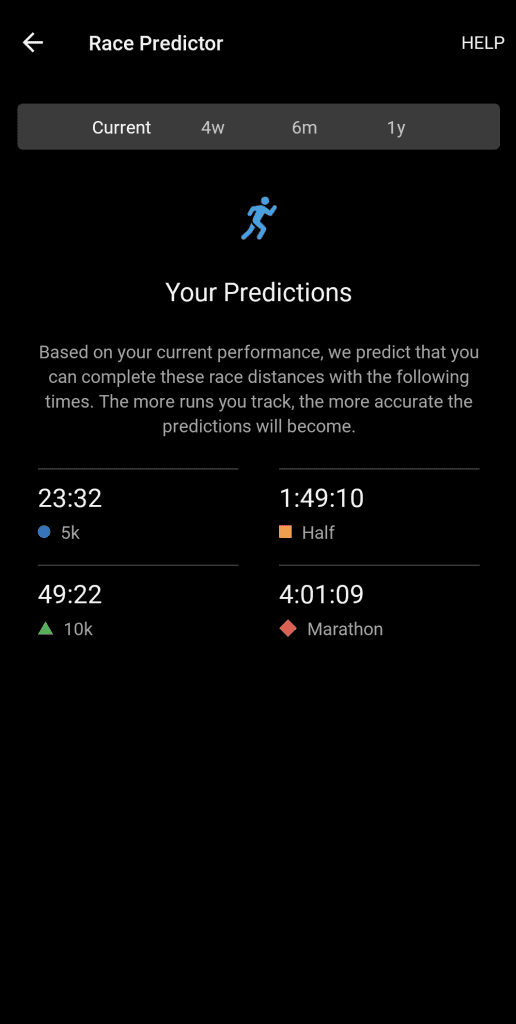
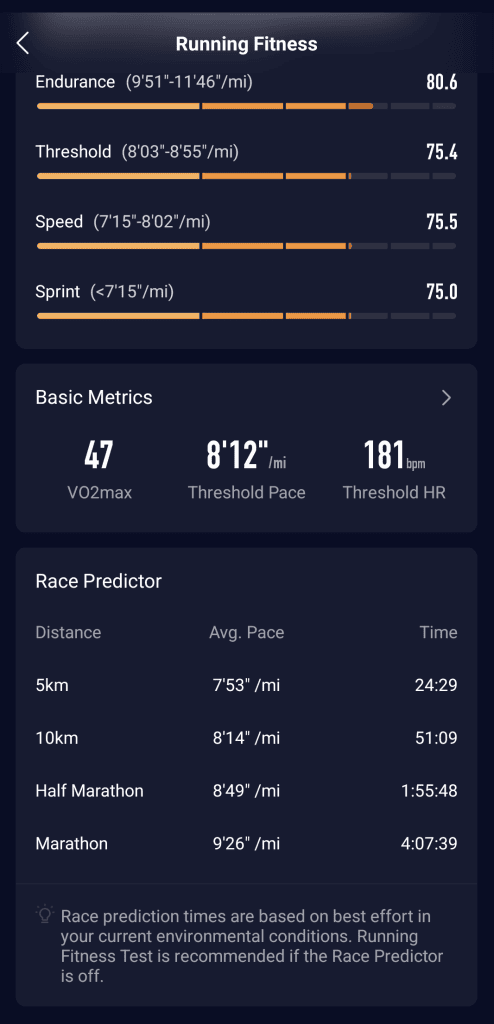
Finally, for the 2026 Mesa Marathon, my predictions were almost the same: 4:04:46 for Garmin and 4:03:31 for COROS. This was one of the first times COROS actually predicted a faster time than Garmin.
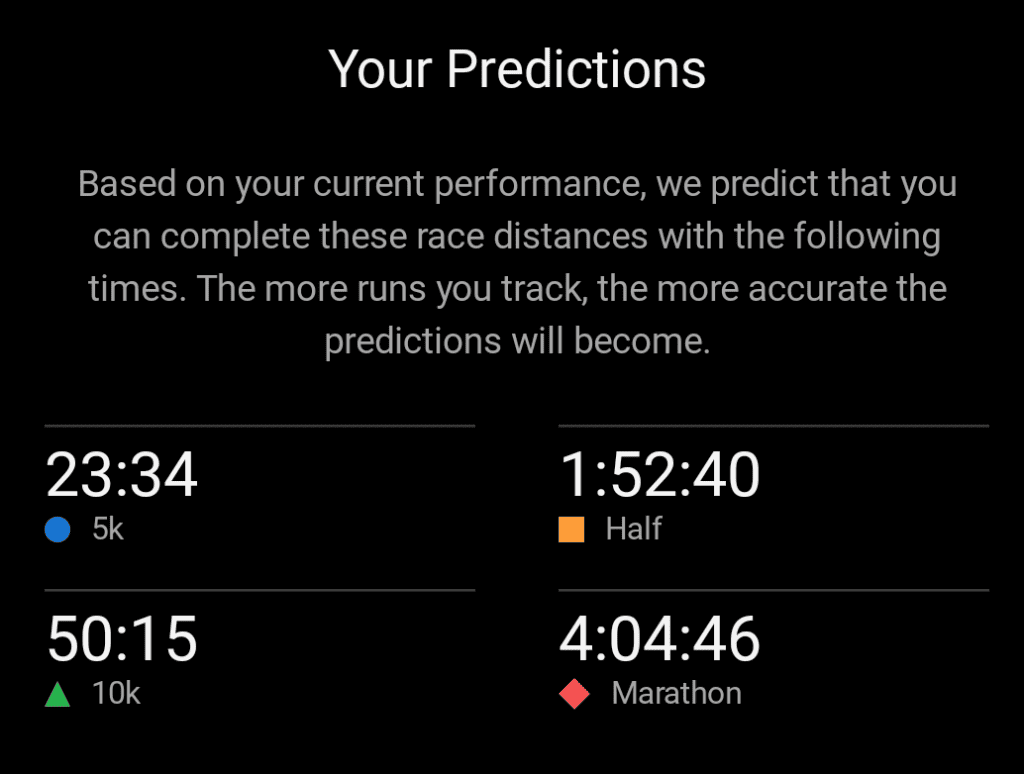
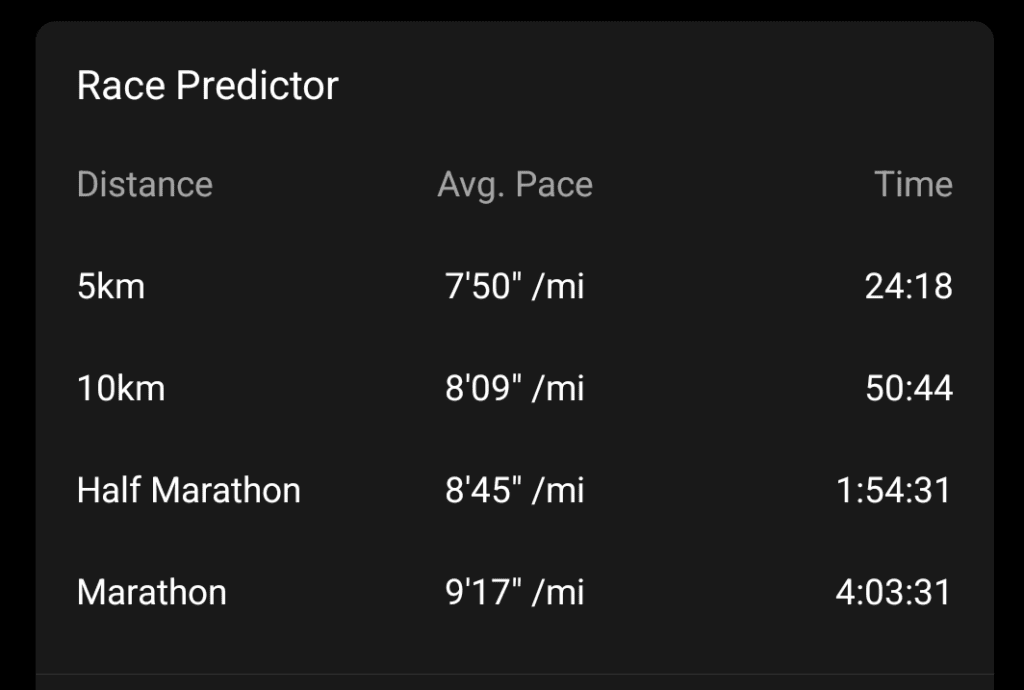
I ended up running a 3:57:29, and I’m grateful that both race predictors had me at a slower pace so I didn’t go out too fast!
Overall, Garmin does seem to predict faster times, but after the first training cycle, the huge gap between COROS and Garmin narrowed and now they’re basically the same. I would err on the side of caution for Garmin times for your first training cycle and still give yourself a buffer of a few minutes. And for COROS, I would be more careful if you’re racing shortly after a decrease in training load.
VO2 max—very similar, but Garmin updates more often
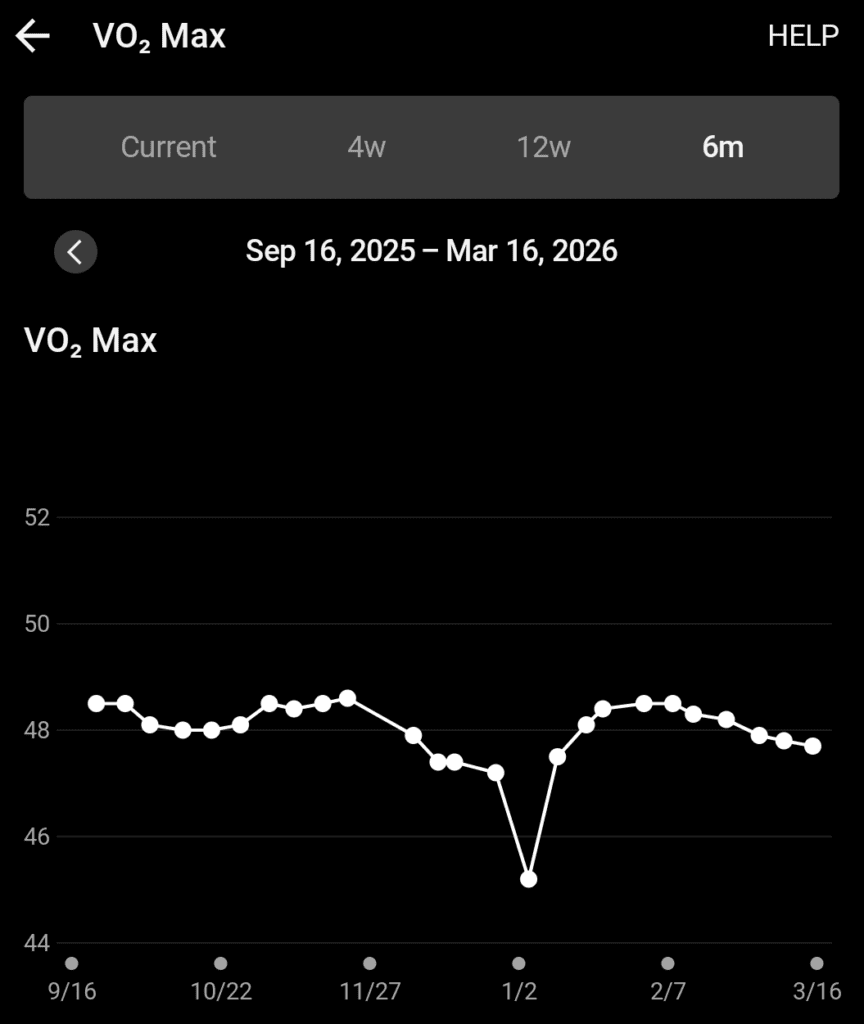
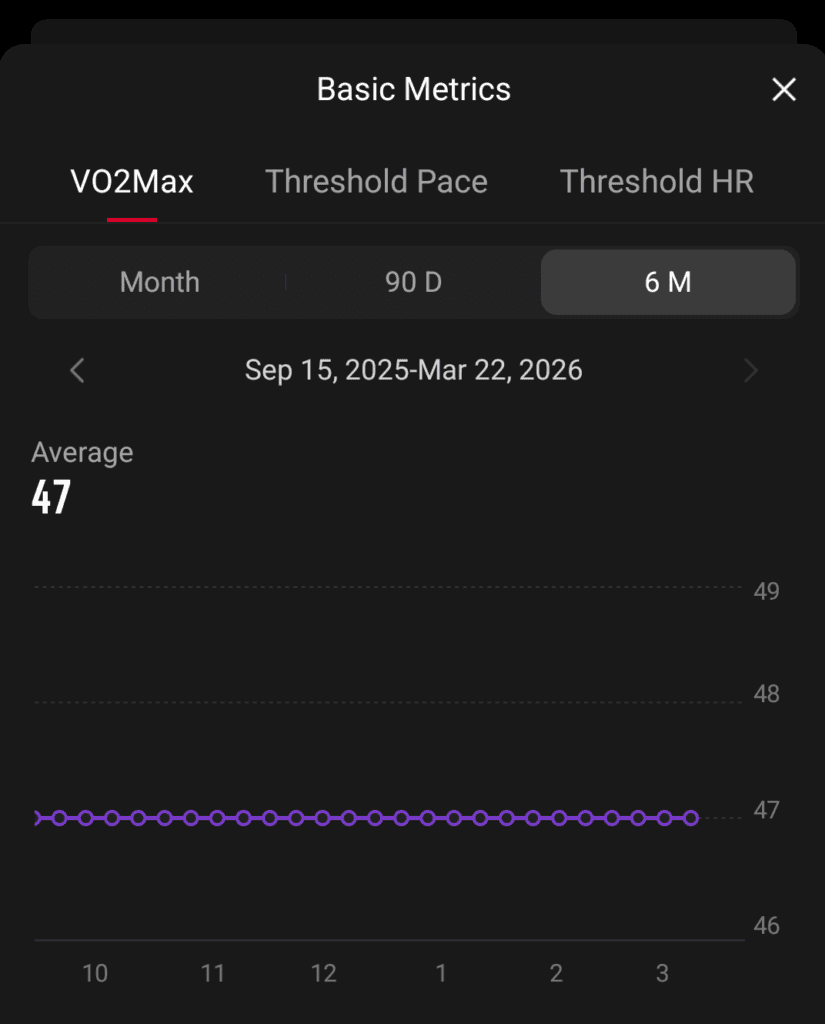
I’ve been asked in the past about the VO2 max metric and how they differ between COROS and Garmin, so I wanted to cover this. Mine was about the same right before the Berlin Marathon: 50 for Garmin and 49 for COROS.
That said, my Garmin VO2 max had been 49 pretty much the entire training cycle, but my COROS one was mainly 47. There was an update in their running performance metrics in spring 2023, and my VO2 max dropped from 49 to 47 then.
For what it’s worth, my VO2 max has been in the 49-50 range during my training cycles over the last few years, so Garmin seemed more accurate.


Currently, my VO2 max is 48 in Garmin and 47 in COROS, so they are now pretty aligned.
I will say though that Garmin seems to have been more responsive in the last year or so, as my COROS VO2 max hasn’t changed at all despite going to higher altitudes. My dip in VO2 max in Garmin was exactly when I went to a higher altitude, and then it recovered after I returned to sea level.
Distance tracked—older COROS watches track slightly shorter distances
On the vast majority of my runs in 2023, the Garmin device I wore tracked a longer distance than the COROS one.
The difference in distance was usually pretty small—usually less than 1%. For example, for the Berlin Marathon, Garmin said I ran 26.59mi while COROS said I ran 26.45mi; that’s a .5% difference.

I took a random sample of 25 road runs in 2023, from distances ranging from 3 miles to 26 miles, and I found that Garmin tracked longer distances by .6% on average.
Of course, this is truly a very tiny difference, and over a month of around 124 miles, this added up to less than .4 miles of a gap between my mileage totals.
Over the last couple years, this tiny gap has gotten even less noticeable, especially with the newer COROS models like the APEX 4 and PACE 4. In fact, when I ran the 2026 Mesa Marathon, my Garmin FR970 and COROS PACE 4 tracked the same exact distance.
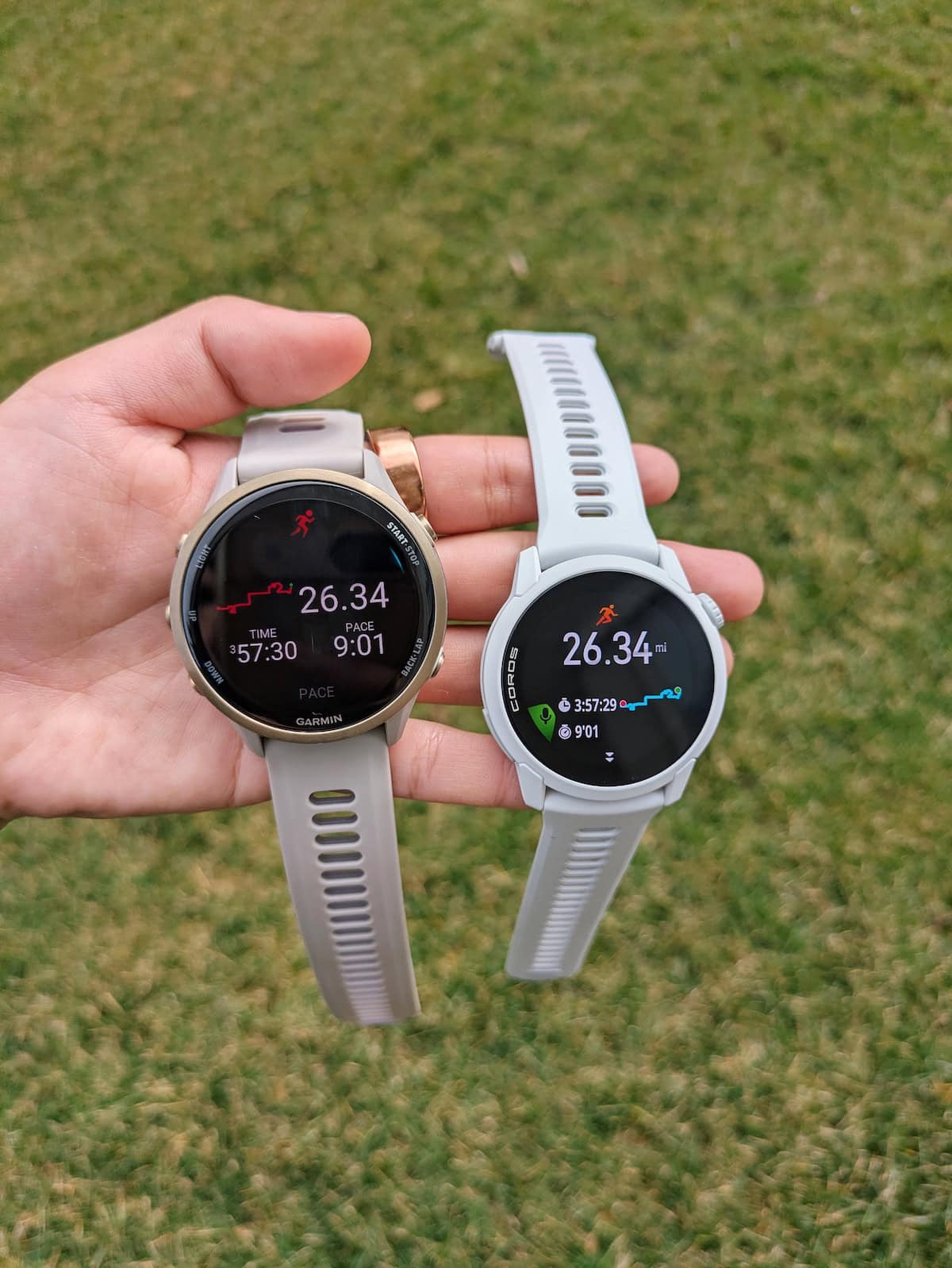
So, I would say that this difference is really negligible unless you’re considering an older COROS like the APEX 2.
The Bottom Line
If you want a watch with more lifestyle and safety features, and supporting fitness/health metrics, Garmin is your best bet. If you want longer battery life and lower-cost multisport tracking, but a simpler watch, I’d recommend COROS.
Personally, I went with COROS in 2021 because I didn’t really use Garmin’s extra lifestyle and safety features. I also wanted open water swimming, navigation, and longer battery life at a lower price. I considered the Garmin Forerunner 745, COROS APEX, and COROS PACE 2, but ultimately went with the APEX.
However, after I tested the Forerunner 255 in 2022, I began to be drawn back to Garmin due to their improved battery life, super accurate GPS tracking, and addition of open water swimming to the Forerunner 200 series. Even though I already had the APEX 2, I bought a used FR255S Music so I could do a long-term comparison like this post.
It’s getting harder and harder to compare the two ecosystems since they both continue adding features to compete with one another. To this day, I actually haven’t really decided to go with just one ecosystem over the other, but I’m in an unusual position as someone who frequently tests GPS watches. It actually makes sense for me to continue gathering data on both Garmin and COROS.
Another weird use case I found for wearing two GPS watches is if you’re an American during a race abroad, and there are only kilometer markers haha. It was actually helpful to see my distance in miles and kilometers on different wrists.
In any case, I don’t think you can really make a “wrong” choice, as long as you carefully consider what features you need. Both ecosystems are overall very reliable and accurate, and I know I’d adapt just fine if I had to pick just one.
If it helps at all, I’ve noticed that trail and ultrarunners tend to gravitate towards COROS (likely due to the better battery life), while more road runners and newer runners tend to like Garmin (likely due to the extra lifestyle and everyday health features).
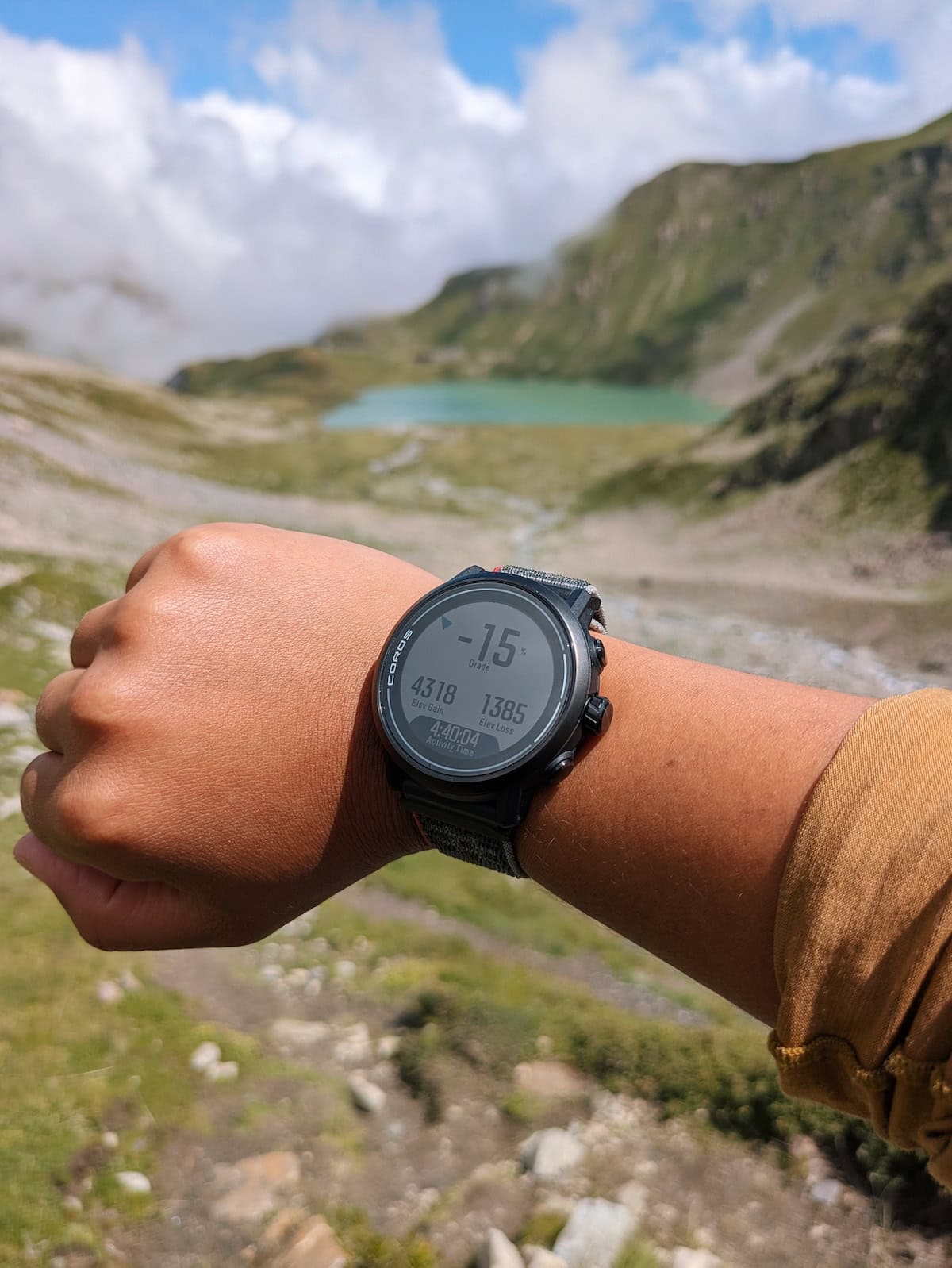
In fact, I only took my COROS APEX 2 on my 12-day trek in 2025 since I knew that it would last the whole day (I ended up being able to squeeze 2 all-day hikes before needing to charge). I knew I wouldn’t be able to do the same thing with my Garmin FR255S.
Best Garmin and COROS Watches
Now, after talking about the ecosystems in general, you’re probably wondering which specific model to get. Here are my recs!
If this comparison helped you, it would mean a ton if you purchased your watch using my affiliate links or codes. I also want to encourage you to buy used or from small, local running businesses if you can. I don’t get paid if you do that, so if you still want to show your appreciation financially, you’re always welcome to buy me a virtual coffee.
If you’re planning to buy a COROS watch on their main site, you can use my code COROS-Lily to get a free, extra watch band or any other accessory (minus gift cards and the explorer pack). Just add both the accessory and the watch to your cart before applying the code at checkout. Please do not share this code on public forums. (I’m not an ambassador or anything, this is just the way they run their affiliate program).
Budget ($250 or less)
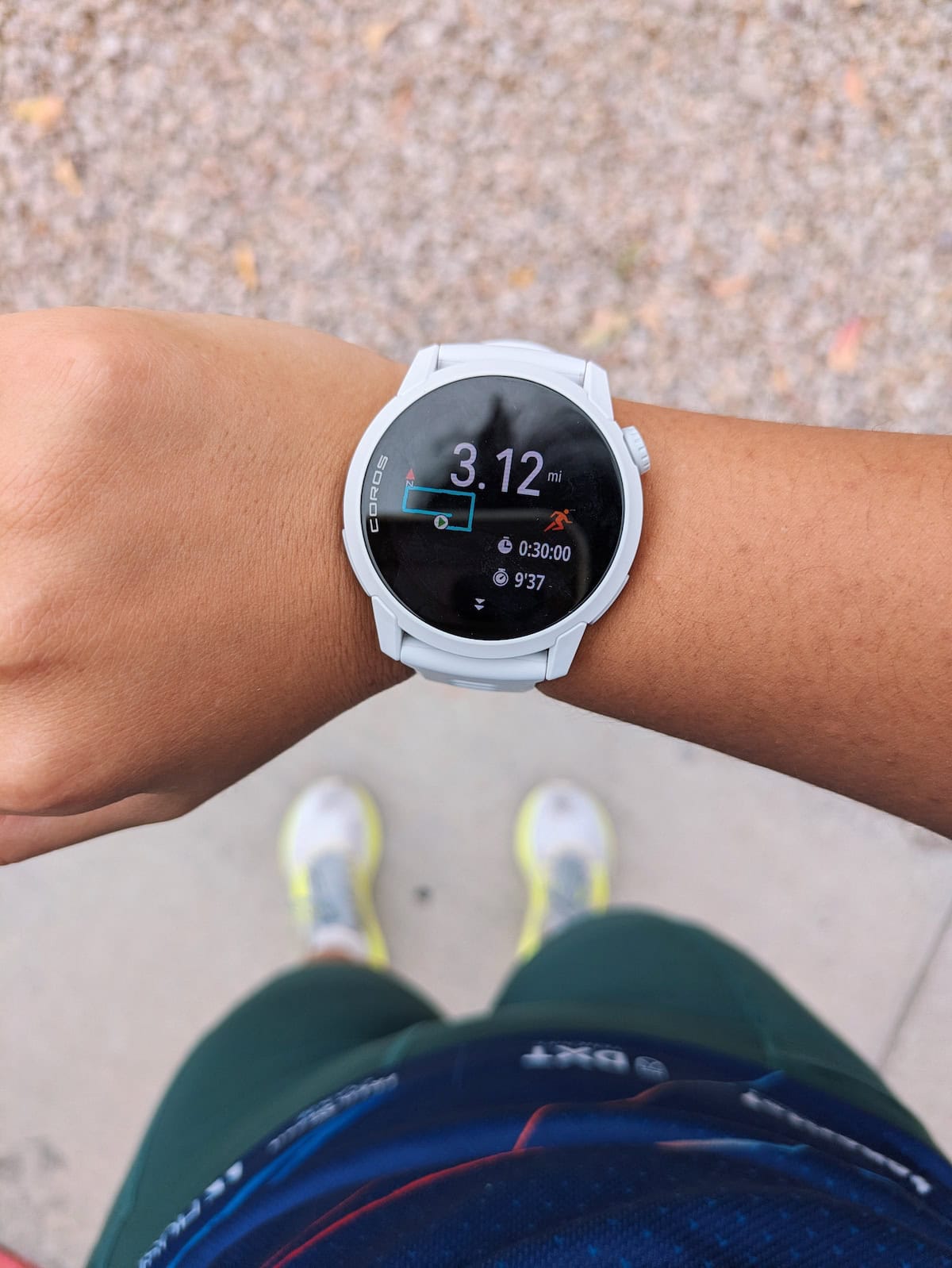
COROS PACE 4 ($250 retail)
Buy from COROS (use code COROS-Lily for a free, extra watch band) or Amazon
- Super light and comfortable to wear at only 32g
- 41 hours of battery life on All Systems tracking and 19 days of regular use
- Tracks open water swimming, triathlon, and trail running
- Extra accurate Dual Frequency tracking option that gives you access to 5 satellite systems at the same time
Garmin Forerunner 165 ($250-300 retail)
Buy from Garmin or Amazon
- AMOLED display and touchscreen
- Music version compatible with Spotify Premium, Deezer, iHeartRadio, and Amazon Music
- Make contactless payments with Garmin Pay
- Tracks trail running and open water swimming

See my comparison of the Forerunner 165 vs. PACE 4 for more info.
Also check out my post on best GPS running watches under $200 for more recs, including older models.
Mid-Tier ($350-450)
Garmin Forerunner 265 ($450 retail) – also consider the older FR255 for a lower price
Buy from Garmin or Amazon
- Has an AMOLED display and touchscreen (but can also be operated only with buttons)
- Has a music version compatible with Spotify Premium, Deezer, iHeartRadio, and Amazon Music, as well as Garmin Pay, allowing you to make contactless payments with your watch
- Has PacePro, LiveTrack, and Incident Detection
- Has trail running, open water swimming, and triathlon
- Comes in a larger and smaller version (265S and 265)
- Has All-Systems and Multi-band mode for more accurate GPS tracking

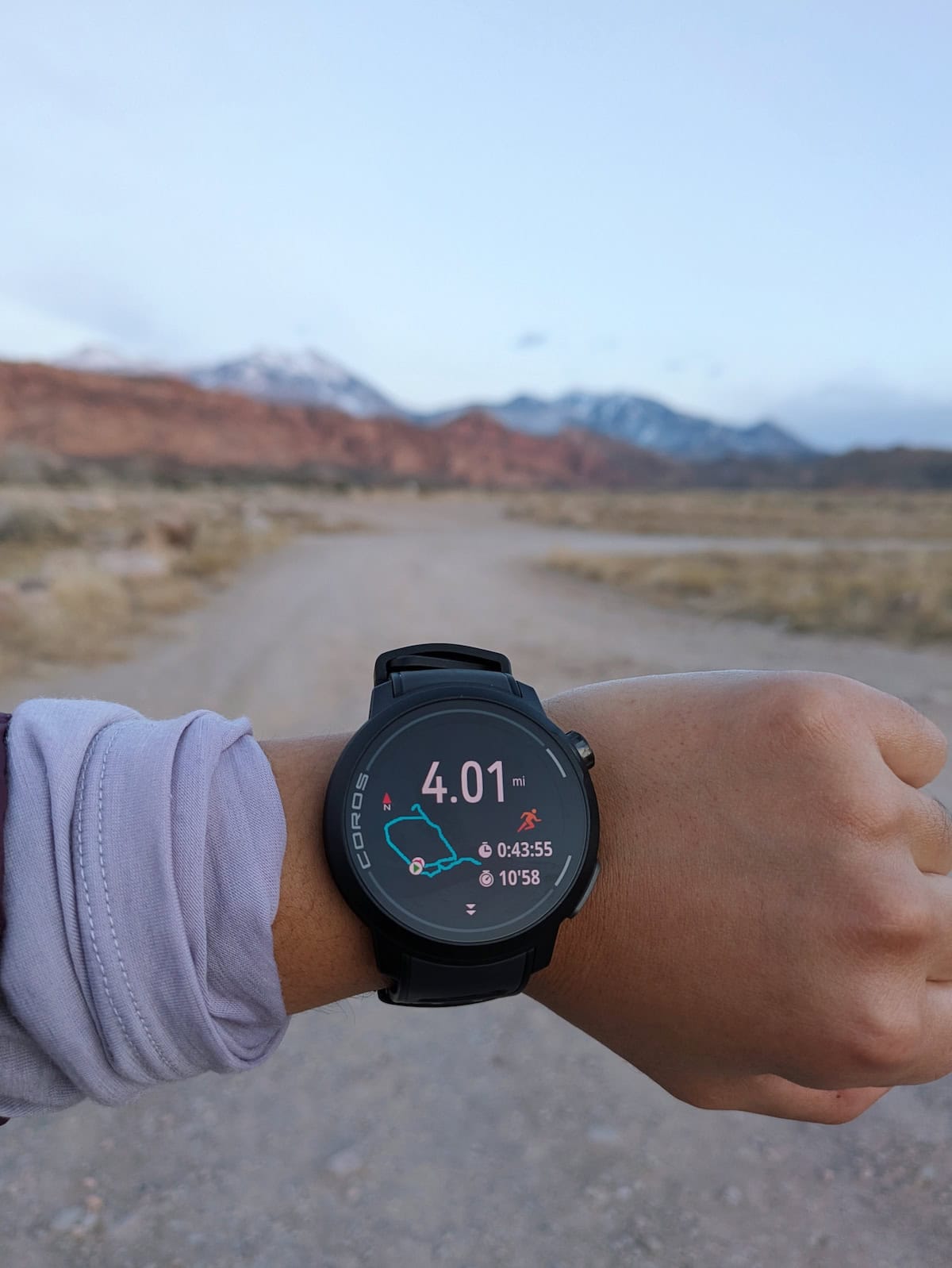
COROS PACE Pro ($350 retail)
Buy from COROS (use code COROS-Lily for a free, extra watch band) or Amazon
- AMOLED display and touchscreen
- 38 hours of battery life on All Systems GPS, 20 days of regular use
- Has navigation capabilities and full mapping (topographic and landscape)
- Tracks open water swimming, triathlon, and trail running
- Has Dual Frequency mode for more accurate GPS tracking
High-End ($430+)
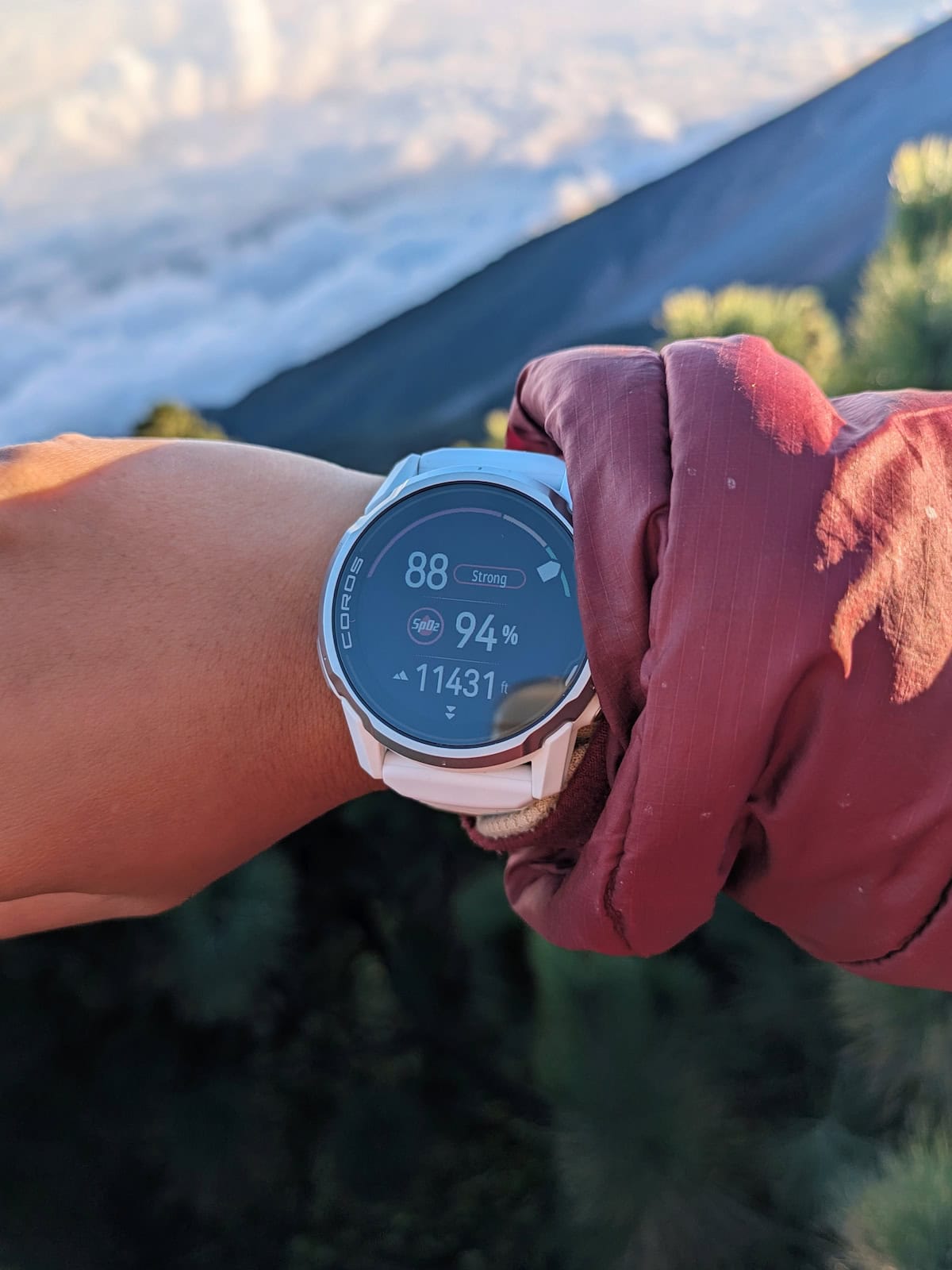
COROS APEX 4 ($430-480 retail)
Buy from COROS (use code COROS-Lily for a free, extra watch band) or Amazon
- Has two sizes, 42mm and 46mm. Has pretty much the same functions as the Pace Pro but a more rugged build + speaker to take calls & get audio alerts
- 15 days of battery life for the 42mm and 24 days for the 46mm. 41 hours and 65 hours GPS tracking for the 42mm and 46mm, respectively
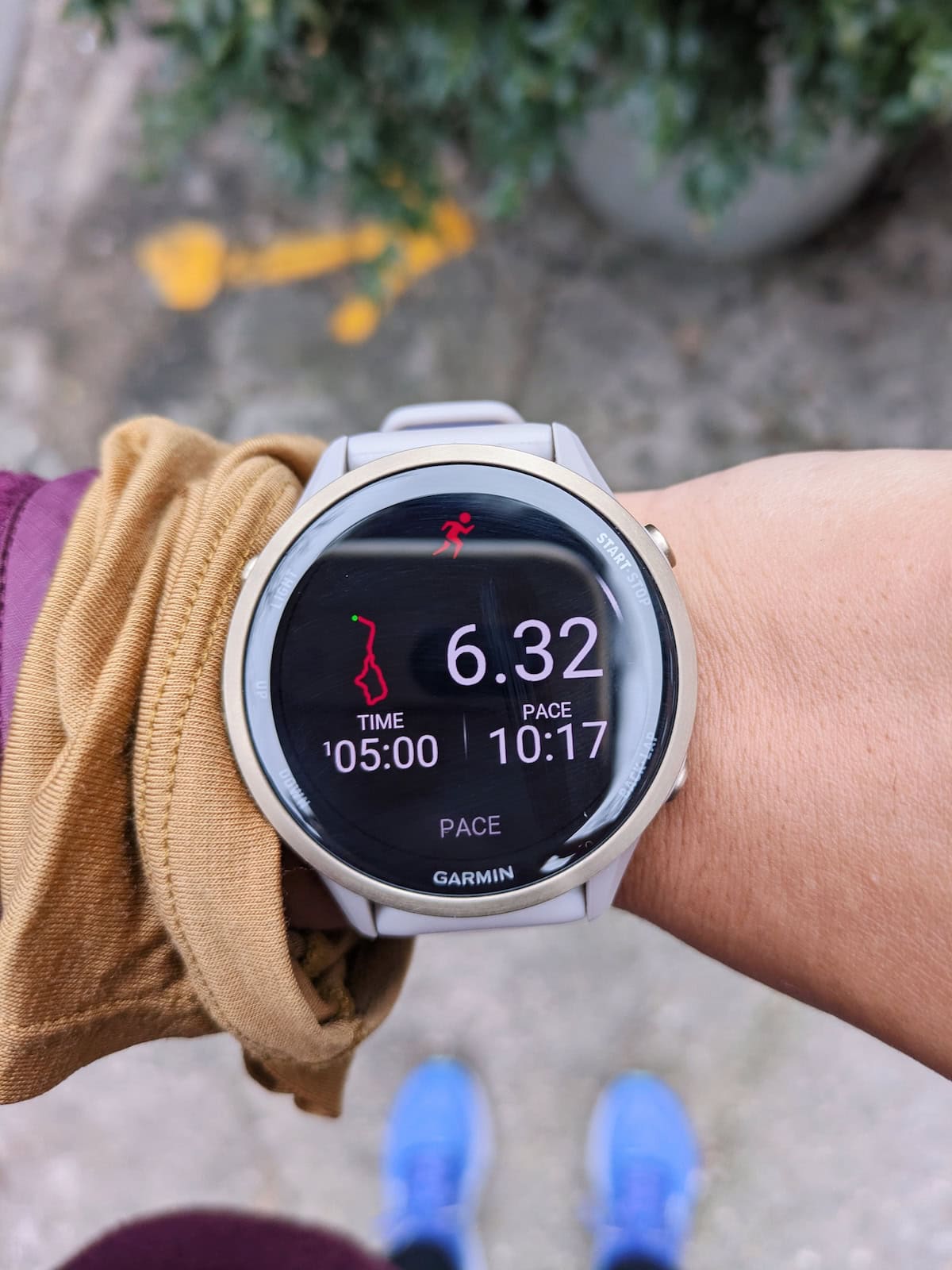
Forerunner 970 ($750 retail) – also consider the FR965 for a lower price
Buy from Garmin or Amazon
- Does everything the 265 does, but also tracks golfing + a wider range of outdoor activities, includes altitude acclimation, has mapping, and is larger
- Up to 26 hours of battery life in GPS mode and 15 days in smartwatch mode
You can also check out these other retailers for deals:
Feel free to leave any questions in the comments, or let us know what you picked and why. Happy running!


That’s a great review and I am so glad that I found your blog. I really liked your review style where you laid out the pros and cons so clearly.
I also have some questions about Coros that you didn’t cover. One thing Garmin really attracts me is the training metrics. I read some reviews saying the training metrics such as estimated VO2max from Coros may be a little off compared to Garmin since Garmin may have better algorithms. I am not sure if you have some comments about it. I Also, how’s the training workouts feature in Coros? Can you do structured workouts on Coros like tempo or intervals?
Thanks a lot!
Hi Serein! Thanks for stopping by. To answer your questions, I haven’t heard that about COROS’ training metrics, and couldn’t find any threads/reviews about it. Feel free to share some with me! I’m surprised to hear that since COROS has very sophisticated algorithms in general, and even uses machine learning in its swim tracking. I haven’t noticed anything off about VO2 max personally. My data is very similar to what I was getting from Garmin (49-50 Garmin vs. 50-52 COROS, though I have improved my fitness, so it makes sense).
I have heard that some athletes have issues with the HR accuracy of COROS (which could impact training stats), but I also personally haven’t experienced that, and would recommend getting an external chest strap if you want very accurate HR measurements during workouts anyways.
And as for structured workouts, yes! I don’t use the feature because COROS automatically shows time paused during workouts, but it’s very easy to set up an interval workout.
Hope this helps!
Thanks for the reply and it is very helpful.
I mostly saw some reviews from Chase the Summit on Youtube where he said the VO2 max is kind of inaccurate for him such as https://youtu.be/vj0LoQBDAwI?t=145. I am not sure about other metrics like HRV, training load, and etc. But it is good to hear you get comparable results.
It looks like Coros has been updating frequently, I may switch to Coros if it can really match Garmin in the training metrics and features. Looking forward to more reviews from you!
Glad it could help! I watched the clip, and from what I understand he said that historically VO2 max was off for him, but at 2:56, he says it looked more accurate after the EvoLab update. I think the main concern people have is with the accuracy of the optical HR sensor (some discussion in the comments of the video about that too).
COROS is definitely updating pretty often, which I appreciate. I wish I could compare Garmin vs. COROS training metrics, but my Vivoactive 3 didn’t have those, though I will the next time I get my hands on a Garmin for a review!
Just following up here in case anyone was following this thread – I ran with both a Garmin FR255S and COROS APEX 2 for a week, and my VO2 max was the same in both ecosystems (49). Training load for both is in optimal range. Training status is a bit different since COROS has run-specific training effect rather than overall training status, but Garmin says I’m productive and COROS said my last run was maintaining my fitness. Hope this can help!
Hello, I heard that the main button of the Coros PACE 2 wasn’t very good and inconvenient to use… What do you think ?
(I run 2 times per week, but I’m hesitating between FR245 and Coros PACE 2)
I actually have a blog post about those specific watches! https://imperfectidealist.com/garmin-forerunner-245-vs-coros-pace-2/
The dial can take a bit of getting used to, but I haven’t had any issues with it, and it’s highly customizable.
Great blog. I’ve been using Garmin devices since I started running in my late 40’s, eight years ago. I’m tempted to upgrade from my current watch. a Forerunner 645 Music, to another Garmin either a 745 or 945. I’ve never used maps in the past and I’ve never used the music function on my current watch. I do have a slight fear of missing out by buying a 945 only to have the 955 released in the next few months. I like the look of Coros devices but wonder how it’ll be converting from one ecosystem to another? I also use a Garmin Edge bike computer. Thanks again for your article…
Glad it could help! If you don’t need the lifestyle functions of the Garmin devices, I recommend COROS. You can import your old Garmin data into the COROS portal. I’m not sure about the compatibility with a bike computer, so I’d recommend reaching out to support about that. They’re very responsive!
Hello I enjoyed your write up on these watches. I have a Garmi. Vivofit 3 that has had it, battery doesn’t last a day now. Looking to a Coros but was concerned about loosing my historical data but you mention being able to import Garmin data to Coros, can you explain what can be imported and how to do it? Thanka. Phil
Hi Phil! COROS actually has a post about it here: https://support.coros.com/hc/en-us/articles/7708736140948-How-To-Bulk-Import-Workout-Data-From-Garmin-To-COROS. Hope this helps!
Thanks I’ll give it a read!
Hi Mark. How did this go for you? I’m exactly in the same boat as you were and looking to switch. Moving into more trail running and have been using garmin for 10 years and seems like I’ve had 5 watches…. Lilly – thanks for the great article!
Did you have any concerns buying the Apex knowing it’s been around for a few years and is no longer receiving updates? I’m training for my first tri and really love that Coros includes triathlon tracking in all models (not looking to spend $500+ with Garmin). I’m stuck between the Pace 2 and the Apex, despite reading as many reviews and comparisons as I can find!
Hey Anna! I did hesitate a bit but ultimately went with the APEX for the trail running features. You can check out my comparison of the APEX and PACE 2 here: https://imperfectidealist.com/coros-apex-vs-pace-2/
I don’t know that I would buy the APEX today if you’re looking for triathlon-specific features and not trail running ones (I bought mine last year). I suspect there will be an update to the APEX this fall and the PACE 2 is super capable.
Hi Lily I have a Garmin Fenix 5, wanting a 6 or 7. I need it to track my streak running. Does Coros offer this?
Hi Ross! Unfortunately, COROS doesn’t have any particular way of recognizing streaks that is similar to the Garmin badges.
Hi Lily, Thanks for the great review! It really helped me make my decision (Pace2) and the discount / free watch band was nice too !! Now to wait for delivery :)
Hi Steven! I’m so glad it could help. The PACE 2 is an awesome watch :)
Hi Lily!
Thank you for this amazing post!
I was using 955 for a year but it developed HR issues and sent back. I travel a lot, alone and don’t really want to grab attention with a fancy Garmin ;-) Apex 2 arrived and I loved it the moment put on my wrist. So light yet robust! However… I do struggle with some undefined cardioviscular issues and want to track my vitals diligently.
And already a simple step count seems so off! I’m wearing 255 and Apex on separate wrists (as you did)
Let’s say it’s 9am I have 300 steps on Garmin and… 90 on Apex.
I even did a test and counted manually 100steps. Garmin picked them up with no hiccup, Coros got… less than 20.
Did you experience such thing in your tests?
Thank you in advance!
Hi Inez! I have not experienced the same thing. I just did the same 100 step test as you with the same watches this morning, and I had 89 on the FR255S and 87 on the APEX 2. I would contact COROS support about that as that doesn’t sound like proper function!
Thanks for this post! I was waffling over getting a Coros vs. a more familiar Garmin & this convinced me to give the Coros a try. I just ordered the Apex 2; if I remember, I’ll come back when I’ve given it a good go.
Awesome! I hope you enjoy it :) Would love to hear your thoughts if you do remember to come back and share!
Hi Lily! Thank you for your review on garmin and coros!
I’m really encouraged by your review, I’ve been using my first coros pace 3. It’s an amazing brand and watch. For me, the brand is also important, because I spent a lot of money to buy this item, and all paid off with the good performance of this watch. I think Coros can compete with Garmin as a luxury and flagship sports watch haha
Something that you don’t mention here that might be very important to users… is that Coros is a Chinese company and they store your data in servers in mainland China. Depending on your preferences and privacy concerns and country of origin, you may or may not want that to occur. Other companies do sell aggregated data (meaning not personally identifiable) openly, but I’m highlighting specifically that your personal data is going to servers in country where you may or may not agree with their privacy policies and governmental oversight.
Hi Lily,
Great review. Just curious if you have had any screen durability issues with the pace series?
Thanks
Dan
Hi Dan! I have not. I know the dead pixel has happened for some people but I have not personally experienced it.
Hi Lily, this review is Awesome thank you. I want to buy my first watch, so I’m between the Garmin Forerunner 255 which can be found on different websites at 250€ and the Coros Pace 4 at 270€, what would you consider and why? I’m training for my first half marathon with in the future to run also a full marathon and also begin with maybe cycling.
Hi Jason! I would go for the COROS PACE 4 since it’s newer and has incredible battery life. But if you need some of the Garmin-specific benefits like livetrack and Garmin Pay, then go for the FR255.
Hi there, I’m stuck between the FR265 and the Coros PACE 4 as they are available at the same price for me right now.
What do you recommend?
I cycle 1hr/day and run 30 mins on the weekend.
I don’t need Spotify/Garmin pay.
Hi JJ! I would say probably the PACE 4 if you don’t need Spotify and Garmin Pay. The battery will last longer and the PACE 4 is a newer model.